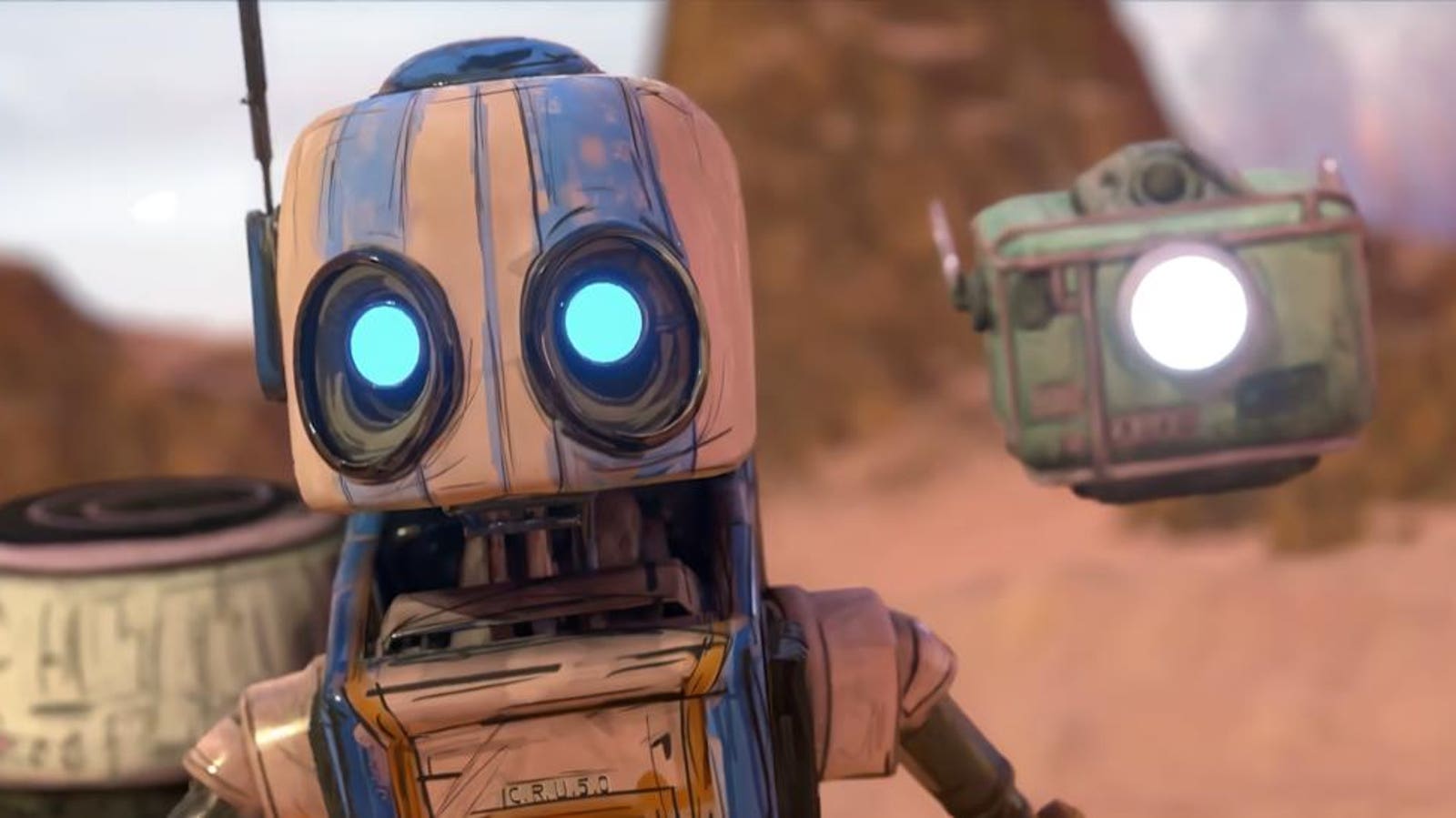
October 2024 marks a milestone in the history of film with the release of Where the Robots Grow, the first feature-length animated film made entirely with AI tools. This 87-minute film, produced by Tom Paton’s AiMation Studios, cost just $8,000 per minute—an unprecedented figure for a professionally animated feature. To put that in perspective, low-budget television animation sourced from overseas studios costs between $10,000 – $20,000 a minute, and it isn’t anywhere near the quality of Where the Robots Grow. What Paton, who wrote, produced and directed Where the Robots Grow, has pulled off with a very small team is remarkable. Cinematic AI is closer than ever, with animation its first successful feature length expression.
Paton, who comes from a background in visual effects, assembled a team of just nine core members to bring Where the Robots Grow to life. The film’s plot is simple and character-focused, set in a distant future where Earth’s survivors send robots to farm a new world, Oracle, in anticipation of humanity’s arrival. The latest model, Cru, stumbles upon a pod carrying the last human baby and must navigate his newfound purpose under the guidance of an AI operating system called POP, a sort of robotic Jiminy Cricket. The cast includes Taylor Clarke-Hill, Nicole Bartlett, and Lee Preston, lending their voices to the robot characters that populate this world.
From a business perspective, AiMation Studios is taking an unconventional approach to distribution. The film is available for free on YouTube. Paton says this is more than just a creative experiment—it’s a business strategy. “This isn’t just about making a movie—it’s about opening up new opportunities,” Paton explains. “With AI, we’re able to break down barriers that have kept so many creators on the sidelines. The arts were a way for the working class to escape where they come from. But that changed, and the system became a closed circle. AI in the hands of creatives from all walks of life around the globe will reverse that change.”
Tom Paton, writer, producer, and director of the world’s first AI feature film, “Where the Robots … [+] Go.”AiMation Studios
With few exceptions, networks, streamers and studios are struggling with debt, high production costs, and shrinking distribution and ad revenue. Despite expectations, there was no production boom following the COVID shut down, and strikes by writers and actors. Speaking at an investor event on May 30th, Sony Pictures Entertainment CEO Tony Vinciquerra said “We are very focused on AI as a way to produce both films for theaters and television in a more efficient way.”
Cru, the naieve young star of “Where the Robots Go,” is voiced by a heavily processed Taylor … [+] Clarke-Hill.AiMation Studios
Where the Robots Grow isn’t just a film; it’s a demonstration of what AiMation Studios can offer to Hollywood. The free release serves as a showcase for the studio’s capabilities, effectively promoting their AI-driven production services and a slate of 10 upcoming projects. As Paton says, “Our goal is to ramp up production so where there would have been 100 crew members on something, now there are ten crew members perhaps.”
The meanacing robot, Number 4, is a snake in the gargen of Eden, who uses naive Cru in order to make … [+] sure humans never set foot on their planet.AiMation Studios
Where the Robots Grow is professionally done. Visually, it’s impressive, especially considering the budget. If you weren’t told AI made it, you wouldn’t know it, which is the way it’s supposed to be. People who know what they are looking at will be amazed by what this small team achieved using AI tools like Adobe Firefly, Stable Diffusion, and custom pipelines. The animation is clean and polished, though noticeably better suited for robotic characters than human ones. The standout moments come from two robots: Number 4, the antagonist and Number 2, Cru’s endearing robotic pet. These characters bring the film its best moments, delivering a mix of tension and heart that resonates. “Taylor Clarke-Hill plays both Cru (Young & Old) and Number 4,” Paton explained. “We used vocal remapping to clone licensed voices over the top of his performance for young cru and Number 4. Old Cru is his natural voice.”Cru ponders his place in the universe in “Where the Robots Grow,” the first AI animated film. AiMation Studios
However, as innovative as the film is, the story is tailored for young children—perhaps seven-year-olds. Whether it will appeal to them is impossible for me to say. It’s an old-fashioned narrative, almost quaint in its simplicity. There are no flashy explosions or high-octane shootouts. The pacing is deliberate, focusing on character development rather than spectacle. Cru, the hero, is naive and earnest, learning about his place in the world with the help of POP, the AI operating system guiding him on his mission.
POP, however, highlights a significant limitation in the technology used to create the film. The character is designed as a tiny human figure, encased in a bubble, and serves as Cru’s moral compass. While the robot characters look great, POP proves that AI still struggles with human likenesses. The character animation feels limited and awkward, detracting from the believability of the character. As Paton himself admits, “It is much easier to make and match shots with robots than it is with humans.”LONDON, ENGLAND – JUNE 16: Tom Hanks poses with characters from Toy Story at the European … [+] Premiere of “Toy Story 4” at Odeon Luxe Leicester Square on June 16, 2019 in London, England. (Photo by David M. Benett/Dave Benett/WireImage)Dave Benett/WireImage
Where the Robots Grow offers a glimpse into the future of filmmaking, where AI tools could radically democratize the industry. Paton likens this moment to the early days of CGI in the 90s, saying, “This is our Toy Story moment. It’s not hypothetical—it’s happening now.” Indeed, just as Pixar’s Toy Story showed what CGI could do for storytelling, Where the Robots Grow may one day be seen as a breakthrough for AI animation. Of course, Paton flatters himself by comparing Where the Robots Grow to Toy Story, which succeeded so spectacularly because of the originality of the story, and the iconic characters Pixar created.
By releasing the movie for free, Paton is betting that the buzz generated by the project will attract attention from studios and investors. As he puts it, “I think it’s important to be first. I think that carries weight to some degree.”
The film can be viewed in its entirety for free here.
Source link
Add a Comment